
7 things to look for in Amsterdam
Choosing a language school is a bigger decision than it looks. You’re investing time, money, and a good chunk of motivation. So it’s worth getting it right. The good news is that a truly great school isn’t hard to spot once you know what to look for. This guide walks you through the seven things that actually make a difference.
Amsterdam is one of Europe’s most international cities, and that shows in the sheer number of language schools on offer. Whether you’re learning Dutch to feel more at home, brushing up your English for work, or picking up Spanish just because you want to, you’ll find plenty of options. The tricky part is figuring out which ones are actually worth your time.

1. Teachers who actually know how to teach
Everything else can be perfect — the classroom, the schedule, the materials — but if the teacher isn’t great, you won’t get very far. The best language schools in Amsterdam hire people with real teaching experience and a genuine knack for it, not just native speakers who happen to be looking for work.
Being a native speaker doesn’t automatically make someone a good teacher. What you want is someone who can read the room, explain things in different ways when something isn’t clicking, keep the energy up, and — most importantly — actually get you talking. That kind of skill usually comes from years in the classroom, not a weekend course. Before you sign up, it’s worth asking: do the teachers specialise in adult learners? How long have they been teaching? Do they have experience helping students reach your specific goal, whether that’s passing the Inburgering exam, reaching conversational Dutch, or something else entirely? A school that’s proud of its teachers will be happy to answer.

2. Small enough groups that you actually get to speak
Here’s the thing about learning a language: you get better at speaking by speaking. Not by listening to someone else speak, not by filling in grammar exercises. By opening your mouth yourself. And in a class of fifteen or twenty people, that’s simply not going to happen very often.
A group of around 6 to 9 students is the sweet spot. Small enough that the teacher knows where each person is struggling, big enough to have real conversations and a good energy in the room. If a school is vague about class sizes or does not mention it on their website, that’s usually not a good sign. And if you want to move even faster, private lessons are always an option. In this case you can set the pace entirely.
Also be aware of schools who add students during the course for commercial reasons. You want to make sure every student in the courses has the same level.

3. Courses built around the CEFR levels
If you’ve ever looked into language learning, you’ve probably come across terms like A1, B2, or C1. These come from the Common European Framework of Reference for Languages, the CEFR. This is the European standard for measuring where you are in a language, from complete beginner (A1) all the way to near-native fluency (C2). A school that structures its courses around these levels gives you real clarity: you always know where you stand, what you’re working towards, and when you’re ready to move up.
But there’s something just as important that often gets overlooked: being in a group with people at the same level as you. Plenty of schools skip this, usually for commercial reasons. Mixing levels fills classes faster, but it’s terrible for learning. If half the group is ahead of you, you spend the lesson lost. If half the group is behind, you spend it bored.
A good language school in Amsterdam will always do a proper placement test before you start and place you in a group where everyone is genuinely at the same stage. It’s one of the clearest signs that a school prioritises your learning over filling seats.

4. Value for money, not just a low price
Language courses in Amsterdam vary a lot in price, and it’s tempting to go with the cheapest option. But price alone doesn’t tell you much. What matters is what you actually get for your money: how many hours are included, how many students are in the class, how experienced the teacher is, what materials are included, and how much support you get along the way.
A useful way to think about it: instead of comparing total course prices, compare how much speaking time you’re actually buying. A smaller class with an experienced teacher will almost always get you to your goal faster, which can mean fewer courses and less money spent overall. The school that looks cheaper upfront might end up costing you more if you find yourself repeating a level or needing extra private lessons to fill the gaps. Also check how many courses you would need to move up one level., because some schools split levels into 3 or 4 parts.

5. A real track record, backed by honest reviews
A school that’s been around for a while and has happy students to show for it is usually a safe bet. Reputation is hard to fake over time. Before you commit, look up independent reviews on Google and see what people are actually saying. Not just whether it’s positive, but whether the comments are specific. Things like “my teacher was brilliant” or “I passed my NT2 exam after taking this course” say a lot more than a generic five-star rating.
It’s also worth asking how long the school has been running. A school with several years of experience teaching adult learners in Amsterdam has had the time to work out what actually works: which approach gets people speaking faster, how to keep students motivated halfway through a course, and how to help people hit their goals without burning out.
The most experienced language schools in Amsterdam with the best reputation are probably Koentact and Language Corner Amsterdam.
6. Teaching that gets you speaking, not just studying
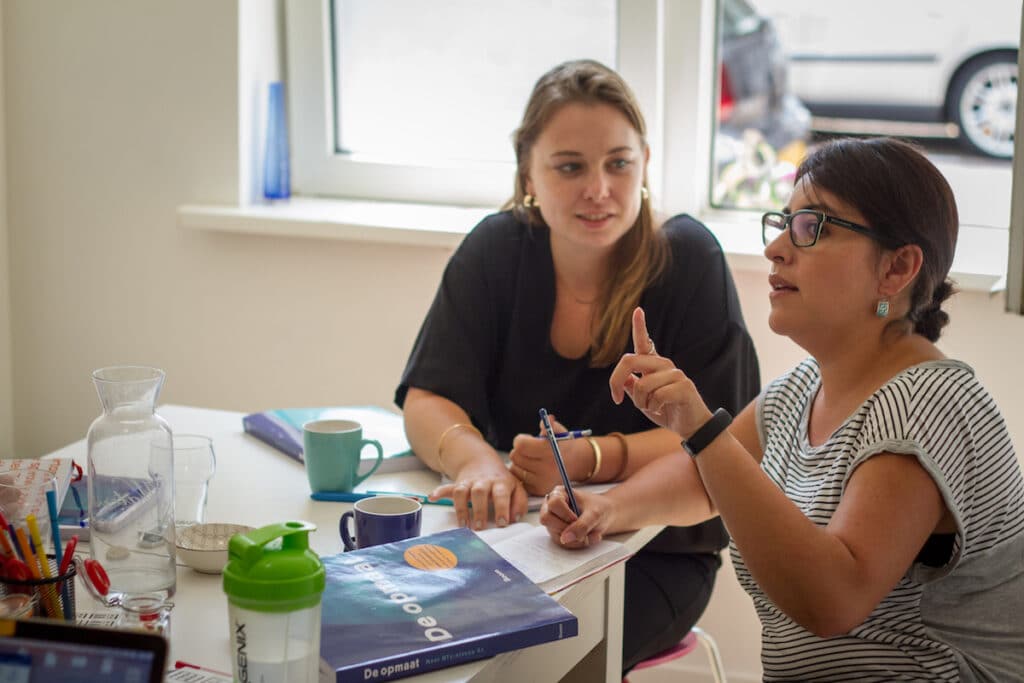
There’s a big difference between learning about a language and learning to use one. A good language school in Amsterdam focuses on the latter. That means lots of actual conversation in class, listening exercises that reflect real life, and scenarios you’ll genuinely encounter: asking for directions, calling your landlord, or navigating a meeting at work.
Before you sign up for a course, ask what a typical lesson looks like. How much of it is spent speaking? Are there role-plays, group discussions, real-world tasks? Schools that teach this way — combining structure with real communication — tend to get much better results than those that rely mostly on textbooks and grammar drills. It’s more fun too.

7. A schedule that fits your life — and a community that keeps you going
Most people learning a language in Amsterdam are fitting it around a job, a family, or both. A school that only offers one fixed timeslot isn’t going to work for everyone. Look for one that gives you real options: morning groups, evening classes, weekend intensives, online lessons, or private sessions when you need to move faster. The more flexible the school, the more likely you are to actually finish what you start.
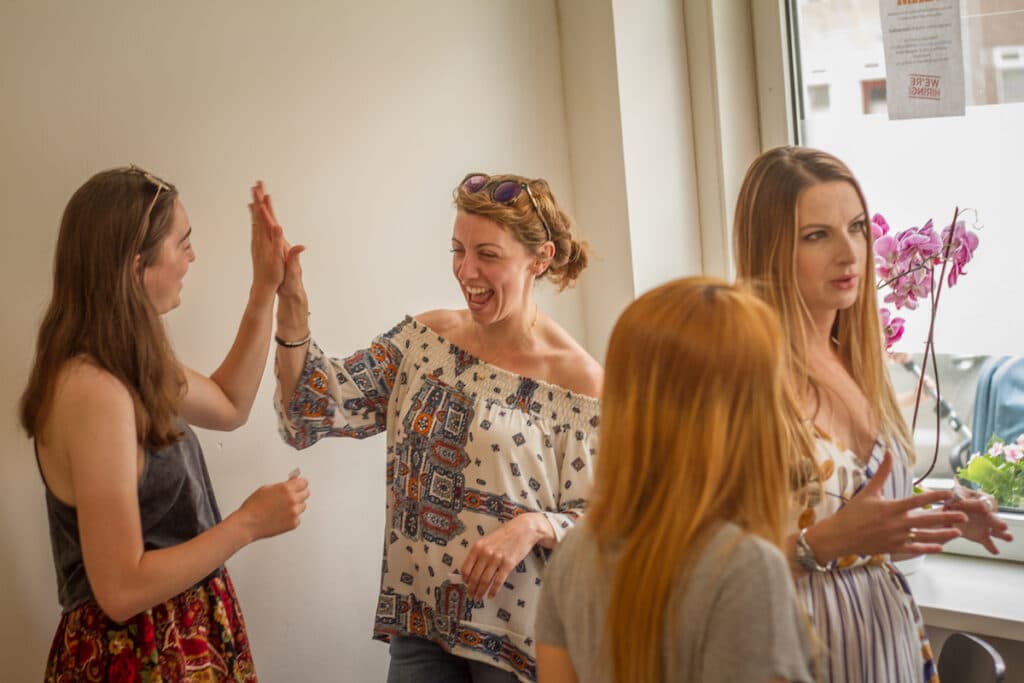
But beyond schedules, there’s something else that really separates good schools from great ones: community. Learning a language is a long game, and motivation matters. The best schools create a sense of belonging with regular social events, language exchange evenings, conversation meetups where you can practise in a relaxed setting outside of class. In Amsterdam, this might be a Dutch chat night, a Spanish conversation session over drinks, or a casual multilingual get-together. These aren’t extras. They’re often where the real progress happens.
One practical thing people often overlook: location. A school that’s easy to get to by tram or metro makes it a lot easier to show up every week. It sounds obvious, but it really does make a difference.
So, which school should you choose?
The honest answer is: the one that ticks all seven boxes. Great teachers, small groups, CEFR-structured courses, fair pricing, a proven track record, communicative lessons, and a schedule you can actually keep. It’s not about finding the cheapest or the most convenient option, it’s about finding the one where you’ll genuinely make progress.
When you’re comparing schools, three quick checks will tell you a lot: ask for a free placement test, find out the average class size, and read recent reviews on Google. A school that’s transparent and confident about all three is usually a good sign.
If you’re looking for somewhere that ticks all these boxes in Amsterdam, Language Corner Amsterdam is worth a look. Small groups of up to 8 students, experienced teachers who specialise in adult learners, courses built around CEFR levels, and a lively programme of free community events on the side. It’s built up a loyal following among Amsterdam’s expat community for good reason. And if you’re not sure yet, a free level test is a great place to start.
Frequently asked questions (FAQ)
The best language school in Amsterdam depends on your goals, but Language Corner consistently stands out for its small group classes of up to 8 students, experienced native teachers, and courses fully structured around CEFR levels. Also based on all the reviews left by students. Since 2015, it has helped thousands of students improve their Dutch, English, and Spanish in a personal and motivating environment. It also runs free community events alongside its courses, making it one of the most well-rounded options for expats and internationals in the city.
Language Corner offers Dutch, English and Spanish courses for all levels, from complete beginner (A1) to advanced (C1/C2). Courses are available in several formats to fit different goals and schedules: small group classes, private one-to-one lessons, online lessons, intensive courses, in-company training, and occasional masterclasses for specific skills. All group courses follow the CEFR framework and are taught by experienced native teachers in small groups of up to 8 students. Language Corner is based in Amsterdam, but also offers online lessons for students who prefer to learn from home.
Yes. Language Corner offers a free level test before you start, so you always begin in a group that matches your current level. This is one of the things that sets Language Corner apart: rather than placing students of mixed levels together, every group is composed of students at the same stage. That means more relevant lessons, better conversations in class, and faster progress overall. And it also means smaller groups of max. 8 students.
The time it takes depends on your starting level, how often you attend and how much you practise outside of class. At Language Corner Amsterdam, Dutch group courses follow the CEFR framework, so progress is structured and measurable. Most students move up one CEFR level after completing a full course, although some levels are split into two parts. Going from complete beginner (A1) to conversational Dutch (B1) typically takes between one and two years with classes twice a week. You can proceed faster if you combine group lessons with Dutch private lessons or immerse yourself in Dutch outside the classroom.
You can find all our events and extra activities of Language Corner Amsterdam on Meetup, but you can also follow the Social Media to keep up to date. Language Corner has an active and friendly community of international people.